
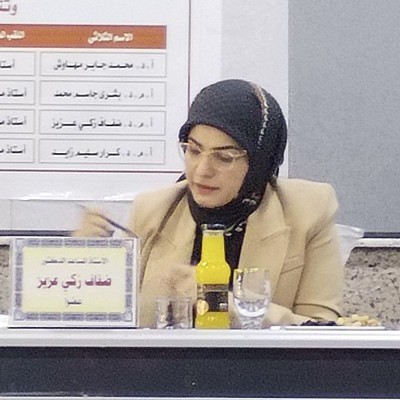
مواقع التدريسيينجامعة الكوفة
dhifaf zeki aziz al-turfy
Assistant Professor

dhifaf zeki aziz al-turfy

0Publications
0Lectures
0Interests
0News

About

Member in Faculty of Science at pathological analyses department
bachelor's degree in biology /Kufa University
master's degree in Biotechnology / University of Babylon

Research Interests

3

Publications

10
2025

The interplay between IL-18 rs1946518 polymorphism, TSH dysregulation, and vitamin D3 deficiency in Hashimoto's thyroiditis

AuthorsNoor Al-Huda Saber Sadiq, Dhifaf Zeki Aziz
JournalHuman Gene
Date2025-12-15
Abstract

Hashimoto's thyroiditis (HT) is an autoimmune thyroid disorder shaped by both genetic predisposition and environmental influences. One gene of growing interest is interleukin-18 (IL-18), particularly its rs1946518 (T/G) promoter polymorphism, which may affect inflammatory responses. Meanwhile, vitamin D3 has emerged as a key immunomodulatory factor, yet its interaction with genetic markers in HT remains unclear

2022

Assessment of blood serum renalase in end stage kidney failure patient in Babylon city

AuthorsSafa Hammodi Lafta, Dhifaf Zeki Aziz
JournalInternational Journal of Health Sciences
Abstract

End-stage renal disease is associated with significant changes in cardiovascular function, fluid, electrolyte, acid-base balance homeostasis, bone metabolism, erythropoiesis, and blood coagulation. Between October and the end of December 2021, the study recruited (30) patients and (20) healthy control subjects. Several physiological parameters, such as (urea, creatinine, renalase, and glomerular filtration rate). The results of the current study showed that the patient groups have significant statistical significance (P≤ 0.05) levels of RNLS, Urea, GFR, and creatinine in contrast with control groups, resulting insignificantly differences (P≤ 0.05).

2020

The Oxidative Stress Induced by the Vapours of Electronic-Hookah on Mice Liver Tissues

AuthorsRasha Shakir Nima, Dhifaf Zeki
Journal2020
Abstract

Background: In the past few years, the increased use of Electronic-hookah is popular among youth in Iraq, raises the need for assessment of these products on liver tissue oxidative stress. The current study aims to examine the oxidative stress induced by the vapours of Electronic-hookah on mice liver tissues. Material and Methods: Twenty mice were randomly separated into two groups. The first experimental group included albino mice were subjected to vapours of Electronic-hookah (1 hour per day for one month), and the other as a control group. At the end of the experiment, several organ weights were measured, and liver tissues were collected for all animals. Liver tissue contents of malondialdehyde, total protein carbonyl, nitric oxide were estimated. Results: The experimental data showed that Electronic-hookah (1 hour per day for one-month) had significant differences between the two groups on the relative weight of the liver and relative weight of spleen. All of the estimated oxidative damage products (malondialdehyde, total protein carbonyl, nitric oxide) were significantly higher (P<0.0001) in the E-hookah group when compared to the animals in control group. Conclusion: Vapours of Electronic-hookah have a harmful toxic effect that can promote worse oxidative stress, especially on liver tissue, which could elevate the risk for the development of liver diseases in a long time.

2019

Investigation of SOD2 gene polymorphism in patients with chronic kidney disease in Babylon province

AuthorsDhifaf Zeki, Samah Amer Hammood Naser Jawad Kadhum
JournalDrug Invention Today
Abstract

Single-nucleotide polymorphisms (SNPs) of antioxidant enzymes may participate to some diseases that can be associated with oxidative stress. Methodology: The blood sampled from chronic kidney disease -hemodialysis patients- (thirty patients) who visit the Dialysis center in Marjan teaching hospital /Babylon /Iraq in addition to the thirty control samples. Results: PCR-SSCP results for SOD2 gene representedthe presence of two different haplotypes due to the numbers of bands in the SOD2gene including 5 and 6 bands, these haplotypes were detected between renal failure patient groups and control, sothisindicatethe association between 5 and 6bands in patients when compared with the control group. Conclusion: The current study conclude that, SSCP technique could be a good way to detect SOD2SNPs in a patient with chronic renal failure.

2018

ANTITUMOR ACTIVITY OF COMPOUNDED DOXORUBICIN IN RD CELL LINE BY HIGH CONTENT SCREENING TECHNIQUE (HCS)

AuthorsDhifaf Zeki Aziz, Merza Hemza Homady1 and Hussein Abdul Kadim2
JournalBiochem. Cell. Arch
Abstract

ABSTRACT : The analysis of novel compound toxicity of the degree of single cell utilize flow cytometry and cellular imagingbased approach has an important role in the discovery out of compounds toxicity. We have a tendency to examine the cytotoxic effects of doxorubicin derivative (DMT) in one cultivated cellular models (RD cell line) by High Content Screening (HCS). The study found that the new compound will reduce cell count, noncontinuous Mitochondrial Membrane Potential (MMP), accumulated - cell wall porosity, nuclear condensation and unleash of cytochrome from the mitochondria into the cytosol-during this study, knowledge showed this new compound could have therapeutic consequences in sarcoma treatment merit additional development. Key words : Antitumor activity, HCS, Doxorubicin, cell viability assay.

2018

CYTOTOXIC ACTIVITY OF COMPOUNDED ANTHRACYCLINE AGAINST RHABDOMYOSARCOMA CANCER CELL LINE

AuthorsMerza Hemza Homady, Hussein Abdul Kadhim2, Khalida K. Abbas Al-Kelaby3, Dhifaf Zeki Aziz1* and Naser Jawad Kadhim1
JournalPlant Archives
Abstract

High selectivity of Cytotoxic Activity of Compounded Anthracycline against Rhabdomyosarcoma Cancer Cell Line that effect of DMT between cancer cell and normal cell line increase the prospects that this compound could serve as leads for novel anticancer drugs and hence may be potential candidates for use in human cancer therapy, however, further investigations will be required in this regard to validate this hypothesis.

2017

ASSESSMENT OF COMPOUNDED DOXORUBICIN IN CARDIAC TISSUE OF EXPERIMENTAL ANIMALS

AuthorsDhifaf Zeki Aziz1, Merza Hemza Homady1, Hussein Abdul Kadim2, Khalida K. Abbas Al-Kelaby3
JournalPak.J. Biotechnol
Abstract

Doxorubicin is one of the most important anticancer agents, but its clinical uses are limited due to cardiotoxicity, the present study evaluated the effects of new derivatives of doxorubicin on cardiac tissue by the measurement of serum cardiac troponin I (cTnI) and CK-BM assays as biomarkers as well as heart tissue after 3 weeks of treatment in albino mice. The results indicated that TnI was significantly elevated (P≤ 0.05) in all studied groups when compared with the control, also serum CK-MB was significantly elevated (P≤ 0.05) in all studied groups except that treated with a new compound when compared with the control group. The histopathological study of heart tissue revealed that the treatment with this compound showed less changes in heart tissue.

2016

Ameliorative Effect of Curcuma longa L. Rhizomes against Biochemical Toxicity Induced by Dichlorvos in Female Albino Rats

AuthorsMaysaa A. Hadi1, Eman H. Hameedi2, Naser J. Kadhum3, Dhefaf Z. Aziz3, Ali H. Al-Saddi1, Haider K. Zaidan1
JournalJournal of Chemical and Pharmaceutical Science
Abstract

Organophosphorus (OP) compounds contain a heterogeneous types of chemicals particularly designed for the command of pests, weeds or plant diseases. The present study mainly focused on the possible potential chemoprotective role of 20% methanolic extract of Curcuma longa L. rhizomes against biochemical toxicity following dichlorvos exposure for 35 days in albino rats (females).

2016

HPLC Fractioning to Study the Synergy and Antagonism of Rue Plant Seeds Alkaloid to Inhibit Topoisomerase II as Antitumor

AuthorsNaser Jawad Kadhim, Dhifaf Zaki Aziz1, Maysaa Adil Hadi2
JournalAmerican Journal of BioMedicine
Abstract

DNA topoisomerases are ubiquitous, enzymes needed to control topological problems encountered during DNA replication, transcription, recombination and maintenance of genomic stability. They proved to be valuable targets for cancer chemotherapy. The seeds alkaloids extract of Rue plant (Peganum harmala L. Zygophyllaceae) were fractioned by high performance liquid chromatography as a suitable technique, HPLC waters company, gradient, Nova-Pak, C18*, 4μm, 3.9x150mm, mobile phase ACN-water pH10.7.

2024

Role of genetically engineered mesenchymal stem cell exosomes and LncRNAs in respiratory diseases treatment

AuthorsSaade Abdalkareem Jasim, Dhifaf Zeki Aziz 2, Yasser Fakri Mustafa 3, Ria Margiana 4, Ameen Abdulhasan Al-Alwany 5, Ahmed Hjazi 6, Ahmed Alawadi 7, Alexey Yumashev 8, Ali Alsalamy 9, Mohammed N Fenjan 10
JournalPathol Res Pract تاريخ النشر 2024
Date2024-01-01
Abstract

The term acute respiratory disease encompasses a wide range of acute lung diseases, which in recent years have been ranked among the top three deadly diseases in the world. Since conventional treatment methods, including the use of anti-inflammatory drugs, have had no significant effect on the treatment process of these diseases, the attention of the medical community has been drawn to alternative methods. Mesenchymal stem cells (MSC) are multipotential stem/progenitor cells that have extensive immunomodulatory and anti-inflammatory properties and also play a critical role in the microenvironment of injured tissue. MSC secretomes (containing large extracellular vesicles, microvesicles, and exosomes) are a newly introduced option for cell-free therapies that can circumvent the hurdles of cell-based therapies while maintaining the therapeutic role of MSC themselves. The therapeutic capabilities of MSCs have been showed in many acute respiratory diseases, including chronic respiratory disease (CRD), novel coronavirus 2019 (COVID -19), and pneumonia. MSCs offer novel therapeutic approaches for chronic and acute lung diseases due to their anti-inflammatory and immunomodulatory properties. In this review, we summarize the current evidence on the efficacy and safety of MSC-derived products in preclinical models of lung diseases and highlight the biologically active compounds present in the MSC secretome and their mechanisms involved in anti-inflammatory activity and tissue regeneration.

Lectures

6

News & Announcements

2
News 2018-01-18

Participate in 3m thesis Competition

The three candidates were selected out of a total of nine participants, where they are required to summarize their thesis in three minutes and in English.

News 2018-01-15

Molecular and Cytotoxicity Study of Compounded Anthracycline in Mice Model of Rhabdomyosarcoma

The public discussion of my doctoral project took place at 10 pm ,the committee was formed by a group of Iraqi university professors

View details