
مواقع التدريسيينجامعة الكوفة
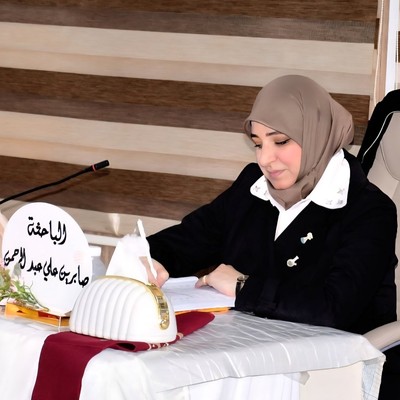
sabreen ali abdalrahman altimimy
Assistant Lecturer

sabreen ali abdalrahman altimimy

0Publications
0Lectures

About

Bachelor of Science in Chemistry, College of Education for Women, University of Kufa, ranked first in the department in 2009. Received the "Promising Students" card for outstanding students. Master of Science in Analytical Chemistry, College of Education for Women, University of Kufa, ranked first in the department in 2026. Worked as a Chemist's Assistant in the Chemistry Department as a daily wage worker in 2010 and as a lecturer in 2011. Appointed as a top-ranked student in 2012. Worked as a teaching assistant in the Physical, Biochemistry, and Analytical Chemistry laboratories until 2024, when I was accepted into the Master's program. Worked as a storekeeper for glassware and equipment. I have received numerous letters of appreciation from ministers, university presidents, deans, and department heads. I have published several international research papers. I have participated in many courses, workshops, seminars, festivals, and conferences, as well as serving on numerous scientific committees. I continue to work in the Chemistry Department, College of Education for Women, University of Kufa.

Publications

2
2026

Determination of Zinc (II) by Cloud point Extraction with Solvent extraction in Different Samples

Authorsصابرين علي عبدالرحمن, ا.م.د جيهان رزاق مسلم
JournalApplied Chemical Engineering
Date2026-08-25
Abstract

Sensitive solvent extraction method with Cloud point Extraction method used for determination of Zinc (II) by organic reagent N-(5,6-dimethoxypyrim-idin-4-yl)-4-((4,5-diphenyl-1H-imidazol-2-yl)diazenyl)benzenesulfonamide and studies ion pair association complex for (NDPDBS) and Zinc2+ in acidic HCl medium shows the wave length of maximum absorbens was λmax=294nm , all studies about optimum condition for giving higher extraction method where, PH=9 as optimum in presence 50 µg Zn2+ in 10 mL aqueous solution, 0.5 mL surfactant Triton X- 100 , and heating temperature at 90 C ̊ For 15 min , 1×10⁻⁴ M (NDPDBS), The stoichiometry show up the composition of ion pair association complex extracted was 1:1 , and addition to other studies such as effect of interferences, electrolyte and else , Statistical values were also recorded for LOD = 0.13904674 ppm ,LOQ = 0.42135377 ppm and Sandell’s sensitivity (2.33×10⁻³ μg/cm2) .

2026

Cloud point Extraction with Onium system for Separation and Determination of Zinc (II) in Different Samples

Authorsصابرين علي عبدالرحمن, ا.م.د جيهان رزاق مسلم
JournalJOURNAL OF KUFA FOR CHEMICAL SCIENCES
Date2026-10-31
Abstract

The cloud point extraction technique has become increasingly popular in recent years for trace metal separation and preconcentration. When heated to a specific temperature, cloud point extraction utilizes the property of nonionic surfactants in aqueous solutions to generate micelles and become turbid (so-called cloud point temperature). For analytical chemists, developing a simple and selective technology for the separation and determination of metals and medicinal drugs is a critical concern. Therefore, a sensitive, accurate, and green cloud point extraction (CPE) procedure was developed for the micro-determination of metal cations like zinc (II) and cadmium (II) in food samples. Triton X–114 and 1-(4-(Phenyldiazenyl) phenyl) azo naphthalene-2-ol (Sudan III) were used as extractants. Sudan III forms an ionpair association complex with metal ions when the pH is 9. In the presence of 5 ppm zinc (II) or 4 ppm cadmium (II) in an aqueous solution, the maximum extraction efficiency should be achieved. In order to create Cloud Point Temperature (CPT) quantitatively, the extraction applications in this approach required heating at 85°C for 20 minutes. In this work, the impacts of different surfactants, pH, stoichiometry, and various organic reagents on interferences as well as spectrophotometric determination were explored. The linearity ranges of zinc (II) and cadmium (II) were 0.25-700 and 0.25-400 ppm, respectively. The results show low detection limits of 0.035 and 0.042 ppm for zinc (II) and cadmium (II), respectively. Also, the quantification limits for zinc (II) and cadmium (II) are 0.116 and 0.140 pp

Lectures

8
View details