Research and development of a two-axis tracking system for the Sun with sensors using Arduino
1- Personal data:
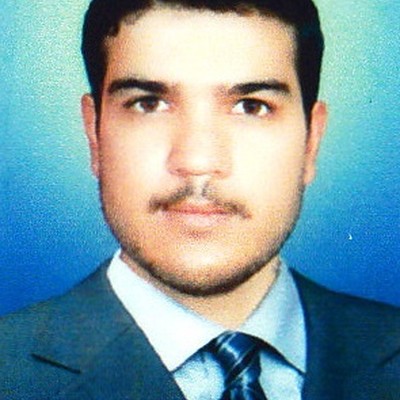
Name: Muhammed Fahim Mansor Alwaeli
Date of birth: 7 April 1983
Nationality: Iraqi
Address: Najaf, Iraq
Telephone no.: Mobile: +9647802864632
E-mail: [email protected]
Languages: Arabic \native language, English \ (Toefl iBT Test –Total scres 91)
, The Russian language\ reading, writing and speaking
2- Educational Background:
• Study: B.SC.in electrical engineering, University of kufa, Iraq
Graduation Projection: (Dispersion Management of Fiber optic channel by using dispersion compensation fiber (DCF))
Graduation year: 2006
• Study: Master's degree (M.Sc.) in Power engineering and electrical engineering - Kazan Power Engineering University - Russian Federation
Graduation Projection: (Researching renewable energy resources in the Republic of Iraq during the creation of power stations)
Graduation year: 2020
3- Professional affiliation:
Member of Iraqi engineering Union, membership No.121857 at 4/10/2006
4- Professional Experience:
I worked in the engineering field
# An employee at the University of Kufa / College of Engineering / Electrical Engineering Department / Laboratories
# Office of the University of Kufa/ Department of Engineering Affairs
# Office of the University of Kufa/ Department of office Affairs
# Participated in the direct implementation project to install and operate the Kufa dates molasses factory
# Execution and work on high and low tension lines, electrical wiring of buildings, maintenance and installation of transformers, control panels for industrial motors and water pumps and building control, maintenance and installation of heating and cooling equipment.
5- Training certificates
- Certificate of training in the State of Lebanon from the Lebanese company (MATLECE).
- I have an international computer certification (IC3 certification).
- Training courses on (Workbench, Matlab, Autocad) programs.
- Car computer cycles, important dynamics and electrical wiring cycle.
6- Other qualifications:
- Participation in holding training courses at the University of Kufa / Department of Continuing Education.

Research and development of a two-axis tracking system for the Sun with sensors using Arduino
Analysis of the change in the power of a solar photovoltaic power plant depending on the level of solar radiation and the value of electrical loads
Modeling a photovoltaic module using the matlab program
Analysis and study of the requirements for the operation of a large-scale solar power plant with an electrical network
Compensation Testing of 10 Gbps Optical system Using Dispersion Compensation Fiber (DCF)
Study of simulation and modeling of a photovoltaic module for the site of Basra in Iraq
This research proposes an intelligent technique designed to optimize the power quality of grid-connected hybrid power systems that use both solar photovoltaic and wind energy. Regrettably, these hybrid systems are liable to the damaging environmental results of weather gusts, which could lessen average system efficiency. Moreover, several faults, such as three-phase faults and voltage fluctuations on the point of common coupling (PCC), can adversely affect system balance. To address those challenges, Static Synchronous Compensators (STATCOMs) are employed to enhance the integration of renewable energy sources (RESs) by providing vital reactive energy support. This examination additionally highlights the importance of advanced optimization techniques for tuning controllers, given the complexity of hybrid systems. The proposed observation indicates the application of a grey wolf optimization (GWO) primarily based on the multi-objective function. This algorithm acts to improve control parameters, thus increasing the system's reliability. The developed strategy is presented in several processes. Scenario 1 shows the system's capability to stabilise at 1 pu during voltage and current swell and sag. Scenario 2 highlights effective reactive power generation during renewable energy source penetration, while Scenario 3 demonstrates improved power quality with unbalanced non-linear loads. Lastly, Scenario 4 confirms that PCC stability is maintained between 0.92 and 0.97 pu during three-phase faults. Through tests, simulation results confirm the improvement of both current, voltage and Total Harmonic Distortion (THD) and reveal the efficiency of the proposed controller in supporting fast dynamic response. Thus, the activity of the proposed system has been verified through tests with the GWO strategy.