
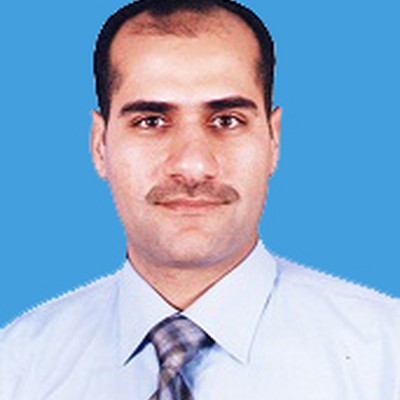
مواقع التدريسيينجامعة الكوفة
ليث محمد رضا كاظم صفرعلي
مدرس

ليث محمد رضا كاظم صفرعلي

English Version
0بحث منشور
0محاضرة
0اهتمام بحثي
0خبر

الملف الشخصي

الجامعة التكنولوجية - بغداد - العراق ماجستير هندسة السيطرة والحاسبات 1998
الجامعة التكنولوجية - بغداد - العراق بكالوريوس هندسة السيطرة والحاسبات 1995
------------------------------------------------------------------------------------------
تدريسي كلية الهندسة - جامعة الكوفة - العراق الان 31/8/2006
تدريسي المركز العالي للمهن الشاملة - درنة - ليبيا 31/8/2006 1/9/2003
تدريسي كلية العلوم -جامعة عمر المختار - البيضاء - ليبيا 31/8/2003 17/1/2000
محاضر خارجي قسم هندسة السيطرة والحاسبات-الجامعة التكنولوجية بغداد - العراق 1998 1997
-------------------------------------------------------------------------------------

-------------------------------------------------------------------------------------
البحوث المنشورة
Photography Analysis Study of Remote Images in Digital Cameras
EN AlShemmary, HR Mohammed, LM Kadhum
International Journal of Video&Image Processing and Network Security IJVIPNS ...
2012

Information Technology and Stand-alone Solar Systems in Tertiary Institutions
Ebtesam N Abdullah AlShemmary, Kadhum Laith M, Al-Fahham Wajeeh Judi
Volume:36, Pages: 369-379 , Publisher: Elsevier
Energy Procedia, 2013

Quantum Dot Cellular Automata models using VHDL-AMS
M Eshghi, LM Kadhum, K Navi
Journal of Babylon University/Engineering Sciences/ No.(1)/ Vol.(22): 2014

A Review of Challenges and Security Risks of Cloud Computing‏
HAS Ahmed, MH Ali, LM Kadhum, MF Zolkipli, YA Alsariera‏
Journal of Telecommunication, Electronic and Computer Engineering (JTEC) 9 …‏
--------------------------------------------------------------------------------------

الاهتمامات البحثية

5

البحوث المنشورة

8
2024

Features, Analysis Techniques, and Detection Methods of Cryptojacking Malware: A Survey

الباحثونLaith M. Kadhum، Ahmad Firdaus, Syifak Izhar Hisham, Waheed Mushtaq, Mohd Faizal Ab Razak
المجلةJOIV: International Journal on Informatics Visualization
التاريخ2024-05-31
مختصر البحث

Various types of malwares are capable of bringing harm to users. The list of types are root exploits, botnets, trojans, spyware, worms, viruses, ransomware, and cryptojacking. Cryptojacking is a significant proportion of cyberattacks in which exploiters mine cryptocurrencies using the victim’s devices, for instance, smartphones, tablets, servers, or computers. It is also defined as the illegal utilization of victim resources (CPU, RAM, and GPU) to mine cryptocurrencies without detection. The purpose of cryptojacking, along with numerous other forms of cybercrime, is monetary gain. Furthermore, it also intended to stay concealed from the victim's viewpoint. Following this crime, to the author's knowledge, a paper focusing solely on a review of cryptojacking research is still unavailable. This paper presents cryptojacking detection information to address this deficiency, including methods, detection, analysis techniques, and features. As cryptojacking malware is a type that executes its activities using the network, most of the analysis and features fall into dynamic activities. However, static analysis is also included in the security researcher’s option. The codes that are involved are opcode and JavaScript. This demonstrates that these two languages are vital programming languages to focus on to detect cryptojacking. Moreover, the researchers also begin to adopt deep learning in their experiments to detect cryptojacking malware. This paper also examines potential future developments in the detection of cryptojacking.

2023

Auto–Transition in RADG based on chaotic System

الباحثونLAITH M. KADHUM، Ahmad Firdaus, Mohamad Fadli Bin Zolkipli, Syifak Izhar Hisham
المجلةIraqi Journal for Computer Science and Mathematics
التاريخ2023-03-02
مختصر البحث

The RADG (Reaction Automata Direct Graph) cryptosystem is the automata direct graph and reaction states combination. The classical RADG does not require key exchange (keyless), or agreement between users just the design of RADG, which is static. The RADG algorithm with keys has two agreements between users, one is on the keys, and other is a design of RADG. The RADG design depends on states and transitions between them, since transitions between states are static transitions, or dynamic transitions have agreement between users to determine the type of state (Jump state, Reaction state) of RADG algorithm with keys, and the transition between states must cover each states scenario of RADG design .This article presents algorithm called (Auto-Transition Function (ATF)), which merge properties of RADG algorithm with chaotic system to obtain on transitions between states are automatic. The parameters of ATF are chaotic initial value, parameter of chaotic function, and characteristics of RADG, then ATF is an auto creation of transitions among all states in RADG, and it satisfies each scenario of RADG design

2021

New formula to calculate the number of designs in RADG cryptosystem

الباحثونLaith M. Kadhum، Ahmad Firdaus, Mohamad Fadli Zolkiplib, Luay Saferalia, Ab Razaka, Mohd Faizal
المجلةInternational Journal of Nonlinear Analysis and Applications
التاريخ2021-05-01
مختصر البحث

Reaction automata direct graph (RADG) is a new technique that uses the automata direct graph method to represent a certain design for encryption and decryption. Jump states are available in the RADG design that enables the encipher to generate different ciphertexts each time from the same plaintext and wherein not a single ciphertext is related to a certain plaintext. This study created a matrix representation for RADG designs that allows the calculation of the number of cases (FQ)mathematically possible for any design of the set Q. FQ is an important part of the function F(n, m, λ) that calculates the total number of cases of a certain design for the values Q, R,P, ψ, J and T. This paper produces a mathematical equation to calculate FQ.

2017

A Review of Challenges and Security Risks of Cloud Computing

الباحثونHussam Alddin S Ahmed، Mohammed Hasan Ali, Laith M Kadhum, Mohamad Fadli Zolkipli, Yazan A Alsariera
المجلةJournal of Telecommunication, Electronic and Computer Engineering (JTEC)
مختصر البحث

Abstract Cloud computing has been an attention in the new era of the IT technologies as there is an increase demand in the services or utility computing all over the wide world web. Security risk resulting from resource sharing throughout the cloud computing becomes one of the most challenging concerns in providing powerful processing and storage as on- demand services. Taking the advantage of low cost derived from the increase in efficiency and performance facilitated by cloud computing, governments and organizations around …

2013

Information Technology and Stand-alone Solar Systems in Tertiary Institutions

الباحثونEbtesam N Abdullah AlShemmary، Kadhum Laith M, Al-Fahham Wajeeh Judi
المجلةElsevier
مختصر البحث

Abstract Currently, the electrical power shortage in Iraq and the existence of programmed stoppage mechanism at the Ministry of Electricity does adversely affects the work of information systems. Videoconferencing is uninterruptable systems which is one of the most important activities in information technology and e-learning systems. The study aims to design solar (alternative) system to run Videoconferencing systems in Iraq. Iraq is one of the ideal countries for the application of such a system in terms of: its geographical location ...

2013

Quantum Dot Cellular Automata models using VHDL-AMS

الباحثونEsam Alkalidy، Mohammad Eshghi, Laith M Kadhom, Kievan Navi
المجلةJournal of Babylon University/Engineering Sciences
مختصر البحث

Transistor is reaching to its physical limits. The search for another technology is full of options. Quantum dot cellular automata among other nanotechnology approaches are strongly nominated to replace the transistor in the digital applications. In this paper we present a Library for the QCA components using VHDL-AMS on the behavioral level. This library will give researchers the required flexibility with building digital circuits for different applications because they can use different types of clocking signals also using the VHDL-AMS environment help to extend the behavioral modeling to dynamical modeling.

2012

Photography Analysis Study of Remote Images in Digital Cameras

الباحثونEbtesam N. AlShemmary، , Hind R. Mohammed, Laith M. Kadhum
المجلةInternational Journal of Video&Image Processing and Network Security IJVIPNS-IJENS
مختصر البحث

Image processing algorithms are being developed for enrollment and correction of multiple adjacent images, channeling the stitched results to an image database for storage/retrieval adapted to the needs of users. The aim of thiswork is to facilitate the capture of high-resolution digital images of decorated surfaces in historical buildings. It will be possible to position the camera repeatedly to an accuracy of 1 mm, using laser positioning devices, with three degrees of freedom on top of the robotic mast, including 360° horizontal rotational movements for the capture of full panoramic images. This paper will refer to the issues of planning on-site photography, positioning of camera and illumination relative to the surface, control of the robotic apparatus, use of calibration charts, processing and database storage of images, and evaluation of the results. The image acquisition software chain and image processing applications including mosaicing techniques will be described in relation to the image capture of faraway surfaces including stained glass windows.

المحاضرات

1

الأخبار والإعلانات

2
الأخبار 2016-12-15

شكر وتقدير

من معالي وزير التعليم العالي والبحث العلمي لنا لتحقيقنا انجازات افتخرت بها جامعة الكوفة باسم مركز الحاسبة 2010

الإعلانات 2016-12-15

محاضرات اضافية لطلبة المرحلة الثالثة قسم الكهرباء

للطلبة الراغبين في حضور محاضرات اضافية لحل تمارين واسئة في موضوع ال Timing Diagrams في مادة المعمارية مراجعتي لتحديد موعد مناسب وباسرع وقت ممكن

عرض التفاصيل